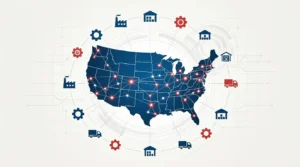
An agency agreement vs distributor agreement in the USA mainly differs in who contracts with the end customer and where risk and control sit. An agent typically sells on your behalf (you contract directly), while a distributor buys and resells in its own name (the distributor contracts downstream).
If you are planning US growth in 2026, the best choice usually comes from a simple question you can answer on one page, do you want control over pricing and customer terms, or do you want speed and local coverage with tighter governance demands?
What should you decide first before choosing agency or distribution?
Quick points for this section
- Contracting party, who signs with the end customer.
- Control vs coverage, pricing, messaging, and customer ownership.
- Risk allocation, warranty promises, returns, and disputes.
- Proof burden, can you document end-users, payers, and downstream chains when banks or enterprise customers ask.
Recent operating reality (late 2025 and 2026) is that “proof” matters more. In US-linked supply chains, counterparties frequently mirror screening and documentation expectations anchored in primary guidance from OFAC (sanctions) and BIS (export controls). Your channel model affects how easy it is to produce that evidence quickly.
How does an agency agreement work in the USA?
Quick points for this section
- The agent solicits orders, but you usually contract directly with the customer.
- You keep stronger control over price, terms, and customer selection.
- You also keep more operational load, contracting, invoicing, and dispute handling land on you.
In a typical agency model, the agent does not take title to goods. That usually means you set the commercial terms and manage most customer-facing legal positions directly. In 2026, this matters because US customers often push hard on warranty scope, indemnities, limitation of liability, and sometimes security and audit annexes. With an agent, you feel that pressure directly, not through a reseller layer.
A common failure point is authority creep. If your documents or emails imply the agent can bind you, you can inherit obligations you did not approve. Your agreement needs clean boundaries on authority, signature process, and what the agent can promise.
How does a distributor agreement work in the USA?
Quick points for this section
- The distributor buys from you and resells, usually contracting in its own name.
- You gain speed and local reach, especially if the distributor already covers your niche.
- You lose control unless you build strong reporting, audit rights, and brand and pricing guardrails.
Distribution often looks simpler day to day because the distributor handles downstream selling. But in 2026, the risk often shifts to downstream opacity. If sub-distributors, integrators, or unexpected end-users appear, you may struggle to produce a clean end-user and payment story when screening or onboarding questions arise. This is exactly where “proof” expectations can slow shipments or payments.
Practically, your distributor contract needs mechanisms, not slogans:
- End-user reporting obligations and escalation triggers.
- Audit rights you can actually exercise.
- Sub-distributor controls, approval requirements and flow-down duties.
- Payment change rules, new payer or bank details trigger a formal review and hold step.
Agency agreement vs distributor agreement in the USA, what differs most?
Quick points for this section
- Agency usually maximizes control, distributor usually maximizes coverage.
- The contracting party drives liability exposure and dispute posture.
- In 2026, documentation and downstream transparency often decide which model scales safely.
Comparison table
Dimension
End-customer contracting party
Title to goods
Pricing control
Customer ownership and visibility
Warranty and claims control
Compliance and documentation burden
Speed to coverage
Agency agreement
Usually you (principal) contract directly
Usually stays with you until sale to customer
Higher, you set terms directly
Higher, you see the end customer directly
Higher control, you set process and approvals
Higher burden on you, but cleaner direct evidence trail
Often slower unless your contract stack is ready
Distributor agreement
Distributor contracts in its own name
Distributor typically takes title and resells
Lower unless guardrails are strict
Lower unless reporting and audit rights are enforced
Risk of over-promising unless warranties and marketing claims are controlled
You depend on third-party evidence, which can be harder to collect fast
Often faster if distributor already has market access
What are the common traps you should avoid in 2026?
Quick points for this section
- Agents that appear able to bind you.
- Distributors that refuse downstream transparency, especially around sub-channels.
- Mixed contracting behavior that breaks ringfencing and invites parent-company exposure.
- Agent authority risk, fix with explicit “no authority to bind” language, clear signing rules, and approval gates.
- Downstream opacity, fix with reporting, audit rights, and sub-distributor approval requirements.
- Payment-change risk, fix by treating new payer, new bank, or split payments as a stop-and-review trigger (this aligns with the evidence-driven approach banks often apply in practice).
For primary baselines shaping US-linked screening expectations, use OFAC and BIS.
How does LANA AP.MA International Legal Services fit into this decision?
Quick points for this section
- Boutique law and economic advisory focused on structured US market entry and Global M&A.
- Headquartered in Frankfurt am Main, with additional locations in Basel and Taipei.
- Cross-border differentiator, a western lawyer admitted in Taiwan, helpful when Asia-linked supply chains shape your risk and documentation profile.
LANA AP.MA International Legal Services (founded 2021, led by Dr. Stephan Ebner) typically supports US market entry decisions where the channel model is part of a larger operating system. That includes contracting-party discipline (ringfencing), enforceable channel governance, and evidence standards that hold up when OFAC and BIS-shaped expectations show up in onboarding, banking, or enterprise procurement. As a neutral trust indicator, the firm has more than 30 verified 5-star reviews (stated as a number only, without client-identifying details).
What should you walk away with?
If you are weighing an agency agreement vs distributor agreement in the USA in 2026, decide based on who must control the customer contract, and who can reliably produce downstream proof when compliance and payment questions arise. Agency models usually raise your workload but keep control. Distributor models usually raise your governance burden but can accelerate coverage. The right model is the one you can operate consistently, with documentation you can defend under scrutiny.
The german article can be found here: Read article