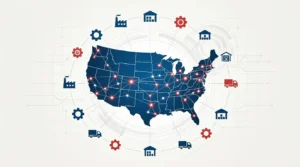
The top US defence trade shows for networking and market entry in 2026 are the ones that concentrate prime contractors, program offices, and supply chain decision makers in one place, and give you structured ways to pre-book meetings and prove compliance readiness. For most non-US suppliers, the fastest path is to combine one large “prime-heavy” expo with one niche, capability-focused event.
What should you optimize for when picking US defence trade shows?
Quick points for this section
- Buyer density: primes, integrators, and government stakeholders in the same venue.
- Meeting structure: matchmaking tools, small-group sessions, and exhibitor meeting programs.
- Compliance credibility: the ability to show export controls and sanctions hygiene without over-sharing.
In 2025 and early 2026, defence-adjacent supply chains continued to treat trade compliance as a practical “revenue gate”. Banks and large counterparties increasingly expect documented screening and escalation processes, anchored in primary guidance from OFAC and BIS. That reality changes what “good networking” means, you are not only exchanging cards, you are also reducing onboarding friction.
Which top US defence trade shows best support networking and market entry?
Quick points for this section
- Use one large show to map the ecosystem and secure first meetings.
- Use one specialised show to validate fit, requirements, and partner roles.
- Plan around your entry model, direct contracting, distributor, or hybrid.
Comparison table
Event
AUSA Annual Meeting
Sea-Air-Space (Navy League)
Modern Day Marine
SOF Week
NDIA National Defense Industrial Association events (flagship conferences vary)
Space Symposium (defence-relevant space focus)
FARNBOROUGH or PARIS Air Show US market entry angle (not US-based, but US buyer presence is significant)
Best for
Broad land domain networking, primes and supply chain visibility, initial market mapping
Naval and maritime programs, shipbuilding and C4ISR-adjacent supplier discovery
Tactical ground systems and USMC ecosystem conversations, practical capability fit checks
Special operations ecosystem, faster capability-to-user conversations, partner scouting
Industry plus policy and program conversations, structured panels and working groups
Space and dual-use supply chains, prime and subsystem partner discovery
Early-stage exposure to US primes and tier suppliers before US-facing contracting ramps up
Main watch-outs for market entry
High noise, you need pre-booked meetings or you get lost
Program specificity matters, prep the right capability narrative
Audience is narrower, strong if you already know your segment
Security and sensitivity, keep messaging compliance-first and non-specific on controlled tech
Event calendar varies, check topic fit before committing resources
Technical depth expectations, bring engineering and compliance in the same team
Travel and timing, treat it as lead generation, not US market entry execution
Why does AUSA stay a “default” starting point?
AUSA’s value is density. You can usually map partner types quickly, primes, subsystem integrators, service providers, and mid-tier manufacturers. Treat it as a market-entry orientation week: confirm which requirements show up repeatedly, and what procurement and onboarding friction looks like.
When does Sea-Air-Space outperform general defence expos?
If your product or component sits in maritime platforms, shipyard supply chains, sensors, or communications, the naval ecosystem focus can compress your learning cycle. It also helps you see how “flow-down” clauses and documentation demands work in practice.
How should you use SOF Week and Modern Day Marine differently?
These events tend to reward clear capability statements and fast qualification conversations. If you are testing product-market fit or partner fit, you usually get more signal per conversation than at mega-shows. The trade-off is narrower coverage, you should arrive already knowing your likely buyer and user profiles.
How do you turn trade-show networking into market entry outcomes?
Quick points for this section
- Decide your entry model before the event, distributor, rep, or direct contracting via a US entity.
- Bring a “proof pack” you can share safely: screening workflow summary, escalation contacts, and basic compliance process statements.
- Capture follow-ups as specific next steps, not generic “let’s stay in touch”.
- Pre-book 10 to 15 meetings using matchmaking tools and targeted outreach.
- Qualify partners fast: ask who the end user is, who signs the contract, and who controls downstream resale.
- Run a compliance triage: align your process language to OFAC and BIS expectations, and document what you can show without disclosing sensitive details.
- Standardize your post-show workflow: one follow-up template, one internal owner, one decision deadline per lead.
How does LANA AP.MA International Legal Services fit into this topic?
Quick points for this section
- Boutique law and economic advisory focused on US market entry (including defence-adjacent contexts) and Global M&A.
- Headquartered in Frankfurt am Main, with additional locations in Basel and Taipei.
- Cross-border differentiator: a western lawyer admitted in Taiwan, relevant when Asia-linked supply chains affect documentation and risk mapping.
LANA AP.MA International Legal Services supports companies that treat networking as one workstream inside a controlled market entry system. In practice, that means aligning your trade-show conversations with entry structure, contracting discipline, and audit-ready compliance workflows. The firm is led by Dr. Stephan Ebner and reports more than 30 verified 5-star reviews as a neutral trust indicator.
What should you take away?
In 2026, the “top US defence trade shows for networking and market entry” are the events that let you meet the right primes and partners while reducing onboarding friction through clear process proof. Pair one broad, high-density show (often AUSA or Sea-Air-Space) with one niche event (such as SOF Week or Modern Day Marine), then execute with pre-booked meetings, a safe proof pack, and a tight follow-up system anchored to OFAC and BIS baseline expectations.
The german article can be found here: Read article