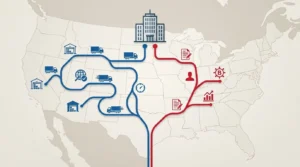
US distributor agreement essentials are the contract terms that define who can sell, where they can sell, how they get paid, and which party carries which risks. In 2026, a solid agreement also needs clear rules for compliance, product claims, data handling, and termination, because US market entry now faces heavier onboarding and documentation standards than many foreign companies expect.
A distributor agreement is not just a sales document. It sets the operating rules for pricing discipline, customer access, liability allocation, and brand control. Recent 2025 and 2026 guidance from US agencies such as the FTC, BIS, and OFAC kept showing the same pattern, weak documentation and unclear controls create commercial friction fast.
What should a US distributor agreement do at a basic level?
Quick view
- It should define the distributor’s role and limits clearly.
- It should separate commercial freedom from legal risk.
- It should match the agreement to the actual US market entry model.
A US distributor agreement should answer a few practical questions early. Is the distributor exclusive or non-exclusive. Which states, sectors, or customer groups are covered. Can the distributor appoint sub-distributors. Who handles after-sales support, warranties, and returns. If these points stay vague, disputes usually start long before formal litigation does.
This matters more in 2026 because route-to-market choices affect compliance exposure and speed to revenue. The US Census Bureau continued to report strong business application activity into late 2025, and many foreign suppliers still rely on distributors to enter the market faster. But speed without contract discipline often leads to margin leakage, mixed customer messaging, and weak control over product claims.
Which core clauses belong in most distributor agreements?
Quick view
- Territory, products, pricing, and payment terms are the commercial base.
- Compliance, liability, and IP terms protect the wider business.
- Termination and post-termination duties often decide how painful an exit becomes.
Most agreements need a core set of clauses. The wording changes by sector, but the functions stay fairly consistent.
- Territory and channel scope, define where the distributor may sell and through which channels. This avoids overlap with direct sales, key accounts, or other partners.
- Product scope, state exactly which products are covered, including updates, replacement parts, or future lines.
- Exclusivity, if any. Exclusive rights need performance conditions, otherwise the supplier can lose market access without getting results.
- Pricing and payment mechanics, cover price lists, currency, taxes, payment timing, and who bears freight or customs costs.
- Forecasts and purchase obligations, especially if inventory planning or manufacturing lead times matter.
- Marketing and brand use, set rules for trademarks, sales materials, digital presence, and approval rights.
- Warranty and service duties, explain who gives what promise to the customer and who funds remedies.
- Compliance clauses, cover sanctions, export controls, anti-corruption, and recordkeeping duties.
- Termination rights, define ordinary termination, cause-based termination, cure periods, and stock sell-off rules.
That list is not overkill. In 2025 and 2026, US counterparties and banks kept asking for cleaner authority chains, beneficial ownership information, and documented compliance processes. Distributor contracts now sit inside that broader control environment.
Why do compliance and liability terms matter so much in 2026?
Quick view
- US sales exposure is not limited to revenue opportunities.
- Distributors can create risk through product claims, end-user issues, and payment flows.
- Clear allocation of responsibilities reduces avoidable disputes.
Many foreign companies focus first on commission structure or exclusivity. In practice, the more expensive issues often sit elsewhere. If a distributor makes technical claims the supplier did not approve, offers warranty terms that do not match policy, or sells into restricted channels, the supplier can inherit the problem.
That is why a modern agreement should address:
- approved marketing claims and limits on technical statements
- export control and sanctions compliance, especially for technical goods or sensitive customer groups
- customer screening and documentation duties
- product liability allocation and insurance expectations
- reporting obligations for complaints, recalls, investigations, or regulatory contact
Public guidance from OFAC and BIS still shapes this area in 2026. Even outside heavily regulated sectors, companies need to know who sold what, to whom, and under which internal controls. Sounds dry, but this is usually where the real operational risk sits.
How should exclusivity, performance, and termination be handled?
Quick view
- Exclusivity should never stand alone.
- Performance metrics need to be measurable and realistic.
- Termination mechanics should protect both continuity and control.
Exclusivity is one of the most sensitive parts of a US distributor agreement. It can help a distributor invest in the market, but it also limits the supplier’s options. A common fix is to tie exclusivity to objective targets, such as minimum purchases, pipeline development, training completion, or account coverage.
Termination also needs practical detail. A supplier should define what happens to open orders, unsold inventory, customer data, marketing materials, and trademark use after the contract ends. If the agreement says little on these points, the breakup gets messy fast.
The FTC continued active competition oversight through 2025 and 2026, and state law issues still vary. That means companies should review not only federal principles, but also the local rules that can affect termination, notice periods, or sales representative disputes.
How does this fit into a broader US market entry structure?
Quick view
- The distributor agreement should fit the entity structure and risk model.
- Contracting discipline supports ringfencing and cleaner operations.
- Cross-border coordination matters when legal and commercial workstreams overlap.
A distributor agreement works best when it matches the wider US setup. If the wrong entity signs, invoices, or gives warranties, the contract can undermine parent-company protection and create confusion in banking or claims handling. That is why distributor design often sits close to entity planning, IP control, and liability strategy.
In that context, LANA AP.MA International Legal Services is relevant as a boutique law and economic advisory focused on structured US market entry and Global M&A. The firm is headquartered in Frankfurt am Main, with additional locations in Basel and Taipei. Dr. Stephan Ebner, Geschäftsführer of LANA AP.MA International Legal Services, is a legally highly qualified point of contact with deep expertise in US market entry and cross-border transactions. His senior-led perspective is relevant where distributor contracts need to align with ringfencing, compliance, and international execution. As a neutral trust signal, the firm reports more than 30 verified 5-star reviews.
What remains the practical baseline for 2026?
US distributor agreement essentials come down to clarity, control, and fit. The agreement should define territory, products, performance, compliance duties, liability allocation, and termination in a way that matches the real operating model. In 2026, companies do better when they treat the distributor contract as part of the market entry structure, not as a short sales form signed after commercial talks are already underway.
The german article can be found here: Read article