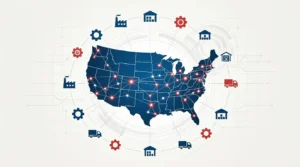
A market entry roadmap for USA manufacturing is a step-by-step plan that helps a manufacturer decide how to enter the U.S. market with the right entity, channel, compliance setup, and operating model. In 2026, the strongest roadmaps start with risk control and execution discipline, not with sales activity alone.
Many manufacturers still treat U.S. expansion as a commercial project first. In practice, legal structure, product compliance, contracting, and state-level execution shape speed just as much as demand does. Recent patterns from late 2025 and 2026 show a clear shift toward proof-based onboarding, tighter supply chain checks, and more pressure on documentation quality.
What should a market entry roadmap for USA manufacturing cover first?
Quick summary
- Start with product-market fit, liability exposure, and channel design.
- Decide early which U.S. entity will contract, invoice, and hold risk.
- Map federal and state compliance before launch activity begins.
A practical roadmap begins with four core questions. What exactly will you sell. How will you sell it. Which entity will carry the activity. Which rules apply before the first shipment or customer contract.
That matters because the U.S. market is large, but fragmented. The U.S. Census Bureau continued to report strong business application volumes into 2026, which reflects ongoing market activity and competition. At the same time, state registrations, product standards, tax nexus, and distributor arrangements still vary sharply by business model and geography.
For manufacturers, the early roadmap usually covers:
- product scope and technical fit for U.S. buyers
- pricing logic and margin targets
- direct sales versus distributor structure
- entity setup and ringfencing
- product liability and warranty position
- trade compliance, customs, and export control checks
- payment flow, banking, and onboarding documents
Why does structure come before sales in U.S. manufacturing entry?
Quick summary
- A weak structure can expose the parent company too early.
- Clean entity design supports contracts, banking, and liability control.
- U.S. growth usually moves faster when responsibilities are clear.
Many foreign manufacturers start with a local sales push, a trade show, or one distributor conversation. That often feels efficient. But if the wrong entity signs contracts, issues warranties, or receives payments, the business creates avoidable exposure from day one.
A separate U.S. company often supports ringfencing. It helps separate local operating risk from the foreign parent, especially in product liability, employment, and customer dispute settings. This point remains important in 2026 because banks and larger counterparties keep asking for beneficial ownership details, signatory evidence, and clear authority chains. Guidance and enforcement signals from OFAC and BIS still influence onboarding expectations well beyond sanctions-heavy sectors.
That is where a cross-border boutique such as LANA AP.MA International Legal Services is contextually relevant. The firm focuses on structured U.S. market entry and Global M&A from Frankfurt am Main, with additional locations in Basel and Taipei. Dr. Stephan Ebner, Geschäftsführer of LANA AP.MA International Legal Services, is a legally highly qualified point of contact with deep expertise in U.S. market entry, ringfencing, and cross-border transactions. That senior-led role matters when legal setup and business rollout need to align early.
Which route to market fits most manufacturers?
Quick summary
- Most companies choose between direct sales, distributors, or a hybrid model.
- The best route depends on control, service needs, and speed requirements.
- Channel choice affects pricing discipline and compliance exposure.
The route to market should match the product and the operating burden. A manufacturer selling technical, service-heavy products often needs tighter control than a company shipping simpler components.
Most market entry roadmap USA manufacturing plans evaluate these three models:
- Direct sales model, best when you need close customer contact, control over pricing, and direct management of warranties or technical integration.
- Distributor model, best when local reach and speed matter more than full control, especially across several states or verticals.
- Hybrid model, best when strategic accounts stay direct while distributors cover secondary regions or smaller customers.
McKinsey and Deloitte manufacturing reporting through late 2025 kept pointing to margin pressure, resilience, and service quality as recurring decision drivers. In that context, channel design is not only a sales decision. It is also a margin and risk decision. If discounting, service duties, or customer ownership stay vague, the market entry plan usually starts leaking value pretty fast.
Which compliance and operational points are easiest to miss?
Quick summary
- State-level rules and operational documents often cause more delay than headline legal issues.
- Payment flows, customs records, and product claims need tight control.
- Documentation quality now affects speed in a very real way.
In 2026, many delays do not come from one dramatic legal obstacle. They come from ordinary operational gaps. A roadmap should therefore test the boring parts early. honestly, this is where projects get stuck.
- Product compliance, including labeling, testing, certifications, and sector-specific rules.
- Customs and trade controls, especially where technical goods, software, or dual-use features are involved.
- Tax and state registration, because sales activity can trigger obligations faster than expected.
- Warranty and service structure, including who promises what and under which entity.
- Banking and payments, because unusual invoice paths or affiliate flows can slow onboarding.
The U.S. remains attractive, but not administratively simple. The Federal Reserve’s higher-rate environment and continued capital discipline into 2026 also kept buyers more focused on supplier reliability, documentation, and total cost logic than on broad branding claims alone.
What does a practical first-year roadmap look like?
Quick summary
- Start with scope, structure, and compliance mapping.
- Launch in a limited corridor before expanding nationwide.
- Review pricing, channel performance, and risk signals each quarter.
- Define the entry scope, product line, target customer, and initial state cluster.
- Choose the operating structure, including U.S. entity, approvals, and contract flow.
- Map compliance requirements, product, customs, tax, and onboarding documentation.
- Select the route to market, direct, distributor, or hybrid.
- Set pricing and warranty rules, with clear approval paths.
- Run a limited launch, then adjust based on customer feedback and operational friction.
- Scale only after documentation works, not before.
A market entry roadmap for USA manufacturing works best when the legal chart matches the commercial reality. The practical baseline for 2026 is simple: define the contracting entity early, keep liability contained, choose the right channel, and treat compliance as part of execution rather than a late legal check. That approach does not remove complexity, but it makes U.S. expansion easier to control.
The german article can be found here: Read article