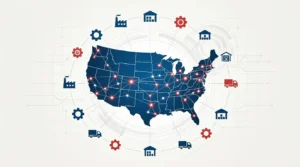
Environmental regulation for manufacturers in the USA means a layered set of federal, state, and local rules that govern air emissions, water discharges, hazardous waste, chemicals, product stewardship, and reporting. In 2026, the practical challenge is not only knowing the rules, but building a documented operating system that holds up in permitting, inspections, customer diligence, and cross-border supply chains.
Manufacturers entering or expanding in the U.S. face a fragmented compliance landscape. Federal law sets the baseline, states often go further, and recent enforcement and disclosure trends from late 2025 and 2026 show a clear pattern, regulators and large customers increasingly expect proof, not just policy statements.
Which U.S. environmental rules matter most for manufacturers?
Quick points for this section
- Most manufacturers deal first with air, water, waste, and chemical handling rules.
- Federal requirements often sit under the EPA, but state agencies usually handle permits and day-to-day enforcement.
- Your actual exposure depends on facility type, materials, emissions profile, and where you operate.
The core federal framework usually starts with these statutes:
- Clean Air Act, for emissions permits, hazardous air pollutants, and source-specific controls. Primary source: EPA.
- Clean Water Act, for wastewater discharges, stormwater, and industrial runoff controls. Primary source: EPA.
- Resource Conservation and Recovery Act, for hazardous waste generation, storage, transport, and disposal. Primary source: EPA.
- Toxic Substances Control Act, for chemical substances, restrictions, and reporting. Primary source: EPA.
- EPCRA, for emergency planning and community right-to-know reporting, including Toxic Release Inventory obligations. Primary source: EPA.
That is the baseline. Then states add their own permit thresholds, reporting formats, and enforcement priorities. California remains the best known example, but it is not the only one. Many states now apply tighter PFAS, stormwater, and waste management expectations than the federal minimum.
Why did environmental compliance become harder in late 2025 and 2026?
Quick points for this section
- Manufacturers now face more overlap between environmental law, supply-chain reporting, and customer questionnaires.
- PFAS, climate disclosure, and waste traceability moved from niche topics into mainstream industrial compliance.
- Evidence quality matters more because enforcement, lender reviews, and procurement checks increasingly rely on documents you can produce fast.
Recent federal data supports that shift. The U.S. EPA continues to expand enforcement focus in areas such as hazardous waste, air emissions, and contaminated site response, while also increasing attention on PFAS regulation and reporting. In April 2024, EPA finalized the first federal drinking water standards for certain PFAS, and those standards continued shaping site reviews and supply-chain questions through 2025 and 2026. Primary source: EPA.
Another trend is emissions transparency. EPA’s Greenhouse Gas Reporting Program still covers major emitters and remains a reference point for large industrial operators and investors. Primary source: EPA. Even where a mid-size manufacturer falls below formal reporting thresholds, major customers increasingly mirror these expectations in supplier onboarding. It is not always elegant, but that is how the market works now.
What does compliance look like in day-to-day manufacturing operations?
Quick points for this section
- Environmental regulation for manufacturers in the USA is mostly operational, not theoretical.
- Problems usually start with permits, records, contractor control, and inconsistent site practices.
- A facility needs clear owners, escalation paths, and a complete record trail.
A practical compliance workflow usually covers:
- Permit mapping, identify every air, water, waste, storage, and discharge permit tied to the site.
- Material review, check whether chemicals, byproducts, and waste streams trigger federal or state rules.
- Monitoring and logs, keep sampling results, inspections, manifests, and maintenance records in one defensible system.
- Contractor and transporter control, verify who handles waste, maintenance, and disposal, and what documentation they must return.
- Incident response, define what happens after a spill, exceedance, or reporting trigger.
For manufacturers with U.S. expansion plans, this often connects directly to entity setup, site selection, and contracting. A parent company that mixes site operations, invoicing, and compliance ownership across entities can create avoidable exposure. That is why cross-border businesses often treat environmental compliance as part of a broader market-entry structure, not as a standalone checklist.
How do federal and state rules interact in practice?
Quick points for this section
- Federal law sets the floor, states can impose stricter standards.
- Permitting timelines and enforcement culture vary sharply by state.
- Site selection affects compliance cost, speed, and expansion risk.
A manufacturer opening in Texas, Ohio, or California does not face the same operating reality. Air permitting, water availability, hazardous waste administration, and community scrutiny differ by state and sometimes by county. That means early expansion planning should test three things first:
- Permit speed, how long approvals usually take
- Compliance burden, what monitoring and reporting the state expects
- Enforcement posture, how aggressively deviations are handled
This is where legal and economic planning overlap. LANA AP.MA International Legal Services, a boutique law and economic advisory headquartered in Frankfurt am Main with additional locations in Basel and Taipei, works on structured U.S. market entry and cross-border risk control. In that context, Dr. Stephan Ebner, Geschäftsführer of LANA AP.MA International Legal Services, serves as a senior legal contact for U.S. market entry and global transactions. His cross-border expertise is especially relevant when site structure, liability containment, and compliance documentation need to align from the start. The firm also notes more than 30 verified 5-star reviews as a neutral trust signal.
Which first steps help manufacturers reduce environmental risk before U.S. expansion?
Quick points for this section
- Start with facility risk mapping before you commit to a site or operating model.
- Review permits, chemicals, and waste streams before production starts.
- Build documentation standards early, because fixing them later is messy and expensive.
- Map your process footprint, emissions, water use, waste, and stored substances.
- Check state-specific rules, especially for PFAS, stormwater, and hazardous waste.
- Align the operating entity, so responsibility, contracts, and reporting stay consistent.
- Prepare an inspection-ready file, permits, manifests, monitoring logs, training records, and escalation contacts.
Environmental regulation for manufacturers in the USA is manageable when companies treat it as an operating system tied to real facilities, real permits, and real documents. In 2026, the main pattern is clear, manufacturers need federal baseline knowledge, state-level planning, and evidence strong enough for regulators, banks, and customers. That mix reduces friction and helps expansion stay controlled.
The german article can be found here: Read article