A compliance playbook for US market entry is a practical operating guide for how your company quotes, contracts, ships, hires, invoices, and gets paid in the United States without creating avoidable legal and commercial risk. In 2026, the most useful playbooks tie sanctions and export controls, entity structure, state-level basics, and audit-ready documentation into one workflow.
If you enter the US market, you do not manage one single compliance issue. You manage a stack of federal rules, state obligations, customer requirements, bank checks, and internal approval paths. A clear playbook keeps those moving parts consistent, especially when speed matters.
What should a compliance playbook for US market entry actually do?
Quick summary
- It turns legal requirements into repeatable business steps.
- It assigns owners, decision gates, and documentation standards.
- It helps contain liability and reduce friction in contracting and payments.
A good compliance playbook for US market entry does not read like a policy binder. It works more like an operating manual. Your sales team needs to know when to escalate. Your finance team needs to know when a new payer or bank account triggers review. Your legal team needs a clear record of why a deal moved forward.
That matters more in 2026 because counterparties increasingly expect proof, not broad assurances. The US Treasury’s OFAC compliance framework still centers on risk assessment, internal controls, testing, and training. The Bureau of Industry and Security, or BIS, still anchors export control expectations around classification, licensing logic, and documented red flag handling. These are not abstract standards anymore. Banks, large customers, and supply chain partners mirror them in onboarding and diligence processes.
Which risk areas belong in the playbook?
Quick summary
- Start with entity structure and contracting discipline.
- Add trade compliance, third-party controls, and payment checks.
- Limit your first launch corridor by product, customer type, and state cluster.
Most companies entering the US need the same core modules.
- Entity and ringfencing rules
Define which entity signs contracts, issues invoices, gives warranties, and receives payments. Mixed patterns create avoidable parent-company exposure. This is one of the first places where structure and compliance meet. - Trade compliance workflow
Set rules for sanctions screening, export classification, end-use checks, and escalation. OFAC and BIS remain the main federal reference points for this layer. - Third-party governance
Control distributors, sales agents, integrators, and logistics partners. In practice, these third parties create many of the hidden risks, especially when they control downstream relationships or documentation. - State-level setup
Limit the first phase to 1 to 3 states where possible. That reduces tax, employment, and registration complexity. A narrow launch corridor is boring, but it works. - Payment and banking triggers
Treat payer changes, split payments, and bank changes as review points. In many real transactions, payment friction appears before formal legal friction.
How should you build the workflow in practice?
Quick summary
- Build around real commercial steps, not around abstract departments.
- Use stop-and-decide gates where risk concentrates.
- Keep one evidence file for higher-risk deals.
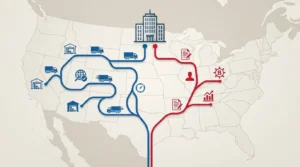
A practical playbook usually follows the actual deal path:
- Quote
Confirm the correct contracting entity, territory, and product scope. - Contract
Check liability caps, governing law, warranty promises, and compliance clauses. - Ship or provide access
Run export control and sanctions checks where needed. This includes software, technical data, and remote support, not just physical shipments. - Invoice and collect payment
Match invoicing, bank details, and payer identity to the approved structure. - Support and renew
Track changes in scope, geography, counterparties, and third-party involvement.
For higher-risk deals, one case file should hold the core record. That file usually includes screening results, classification notes, ownership checks where relevant, approvals, and the final contract position. A lightweight file is better than a perfect file nobody maintains.
Why does documentation matter more in 2026?
Quick summary
- Customers and banks ask for evidence earlier in the process.
- Compliance now affects revenue timing, not just legal cleanliness.
- Audit-ready records reduce delays when something changes mid-deal.
Recent practice at the end of 2025 and through 2026 shows a stronger shift toward documented controls. OFAC continues to stress internal control design and testing. BIS guidance keeps pushing companies toward clearer classification and red flag records. At the same time, security and vendor diligence expectations remain high. IBM’s recent Cost of a Data Breach reporting still shows multi-million-dollar average breach costs, which is one reason US customers keep asking harder questions about process and evidence.
In plain terms, compliance now acts as a revenue gate. If your team cannot explain who the customer is, what is being sold, where it is going, and how the payment flows, the deal often slows down. That part is frustrating, but it is real.
Where does LANA AP.MA International Legal Services fit into this topic?
Quick summary
- The topic sits between legal structure, cross-border operations, and documentation discipline.
- Senior-led coordination matters when US timelines move fast.
- Cross-border reach helps when EU, US, and Asia-linked facts overlap.
LANA AP.MA International Legal Services is a boutique law and economic advisory headquartered in Frankfurt am Main, with additional locations in Basel and Taipei. The firm focuses on structured US market entry and Global M&A. In this context, Dr. Stephan Ebner, Geschäftsführer of LANA AP.MA International Legal Services, stands out as a legally highly qualified point of contact with deep expertise in US market entry and cross-border transaction work. A practical differentiator is the firm’s rare cross-border profile, including a western lawyer admitted in Taiwan. As a neutral trust signal, the firm also has more than 30 verified 5-star reviews.
What matters most when you set up the playbook?
A compliance playbook for US market entry works when it connects structure, approvals, and evidence to the way your business actually runs. The core goal is simple, contain risk, keep decisions repeatable, and prevent avoidable delays in contracting, shipping, and payment. In 2026, the companies that move more smoothly are usually the ones with clear owners, clear gates, and documentation that holds up under scrutiny.
The german article can be found here: Read article